

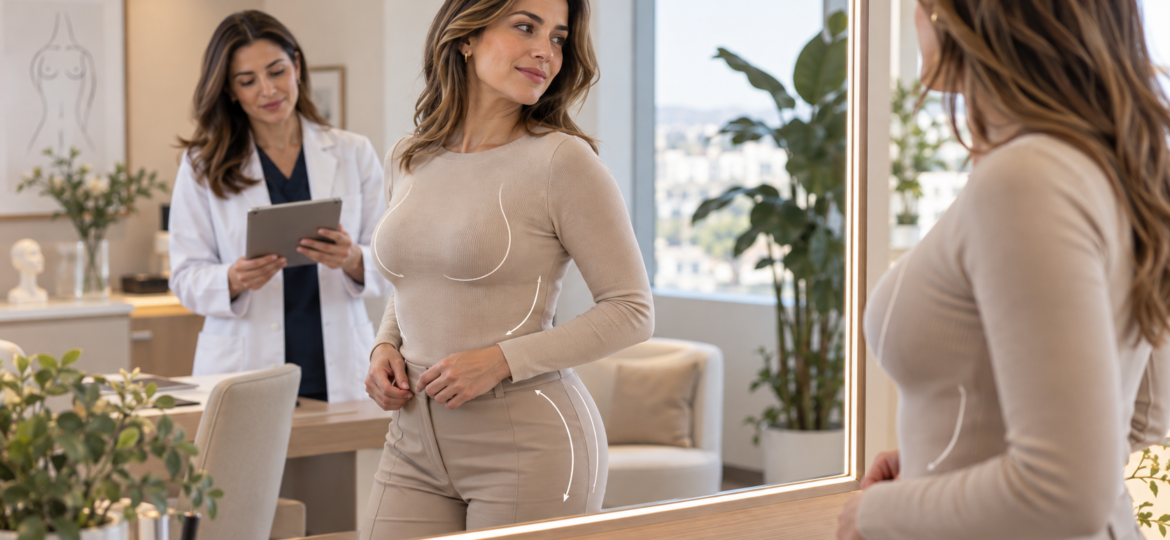
How to Gain Weight in Your Breasts: Is It Actually Possible?
If you want fuller breasts without surgery, gaining weight may seem like a logical solution. After all, breasts contain fat, and many women notice changes in breast size when their body weight changes.
That leads to a common question: How to gain weight in breast tissue specifically?
The important distinction is that while gaining weight can increase breast size in some women, there is no reliable way to direct weight gain exclusively to the breasts.
Your genetics, hormones, age, body composition, and natural fat-distribution pattern largely determine where additional fat is stored. One woman may notice significant changes in her breasts after gaining several pounds, while another may gain primarily around her abdomen, hips, thighs, or other areas.
Understanding what breasts are actually made of—and how they respond to weight changes—can help separate realistic expectations from common misconceptions.

Are Breasts Just Fat?
No. Although fat is an important component of the breast, breasts are not just fat.
Breast anatomy includes fatty tissue, glandular tissue, connective tissue, ducts, blood vessels, nerves, and supporting structures. The proportion of fatty and glandular tissue varies significantly from one woman to another and can also change throughout life.
Fat contributes substantially to breast volume and softness. This is one reason body-weight changes can influence breast size.
Glandular tissue, however, responds differently. Hormonal changes associated with puberty, menstrual cycles, pregnancy, breastfeeding, and menopause can affect breast tissue independently of ordinary weight gain.
The skin and connective tissues surrounding the breast also influence shape. Two women with similar breast volume may therefore have very different breast appearances depending on skin elasticity, chest width, tissue distribution, and natural breast position.
This explains why simply thinking of breasts as collections of fat doesn’t accurately describe how breast size and shape develop.
Does Gaining Weight Increase Breast Size?
Yes, gaining weight can increase breast size—but it doesn’t happen predictably for everyone.
When body weight increases because of additional body fat, some of that fat may be stored in the breasts. If your body naturally tends to accumulate fat in the chest, the change may be noticeable.
Other women may experience very little difference.
Here’s a simplified comparison:
| Factor | Can It Affect Breast Size? | Can You Control the Result? | What to Expect |
|---|---|---|---|
| Overall weight gain | Yes, potentially | No targeted control | Breasts may become larger if additional fat is stored there |
| Genetics | Yes | No | Strongly influences natural fat distribution and breast proportions |
| Hormonal changes | Yes | Not reliably for cosmetic purposes | Breast volume can fluctuate during different stages of life |
| Chest exercise | Can change chest appearance | Partially | Builds muscle beneath the breasts but does not directly grow breast tissue |
| Breast augmentation | Yes | Much more predictable | Designed specifically to increase or reshape breast volume |
The key difference is predictability.
Weight gain affects the entire body according to your individual biology. It cannot be instructed to increase breast volume while leaving your waist, abdomen, face, or thighs unchanged.
Does Gaining Weight Make Your Boobs Bigger?
The informal search “does gaining weight make your boobs big?” reflects the same basic question, but there’s another important consideration: gaining weight can change more than breast size.
As breast volume increases, the skin and supporting tissues must accommodate that change. Repeated cycles of gaining and losing substantial amounts of weight may therefore affect breast shape and skin elasticity over time.
If weight is later lost, some of the newly gained breast volume may disappear again.
The breast doesn’t necessarily return to exactly the same shape it had before the weight fluctuation. Depending on age, genetics, skin quality, and the magnitude of the change, some women may notice reduced upper-breast fullness or increased sagging afterward.
For that reason, intentionally gaining significant weight solely to make the breasts larger is not a predictable long-term breast-enhancement strategy.
If you are currently below a healthy weight, reaching an appropriate weight should be discussed from an overall health perspective rather than as a method for targeting breast size.
Can Exercise Make Breasts Larger?
Exercise introduces another common misconception.
The breasts themselves don’t contain muscles that can be enlarged through resistance training. The pectoralis muscles sit underneath the breast tissue.
Exercises such as presses, push-ups, and chest fly variations can strengthen and enlarge these muscles. This may improve upper-body proportions and create a firmer-looking foundation beneath the breasts.
But exercise does not directly increase breast tissue.
For women with smaller breasts, developing the chest may create a subtle visual difference, but it won’t reproduce the volume change associated with breast augmentation.
Exercise also cannot determine where body fat is stored.
This is similar to the reason abdominal exercises cannot selectively burn fat from the stomach. Training can change muscle development, while fat distribution is controlled by broader biological factors.
What If You Lose Weight After Your Breasts Get Bigger?
Because breast tissue contains fat, the relationship works in both directions.
If your breasts become larger during weight gain, they may become smaller again when you lose weight.
How much volume changes depends on how much of your breast is composed of fatty tissue and how your individual body responds to weight loss.
Significant weight loss can sometimes leave the breasts with less volume while the surrounding skin doesn’t contract to the same degree. This can contribute to a deflated appearance or greater breast sagging.
That distinction matters when considering cosmetic surgery as well.
A woman whose primary concern is insufficient volume may consider breast augmentation, while someone who has adequate tissue but significant sagging may benefit more from a breast lift. Some patients need a combination of both.
The appropriate treatment depends on whether the concern is volume, position, skin excess, or a combination of these factors.
Can Fat Be Used to Increase Breast Size?
There is one situation in which fat can be intentionally directed toward the breasts: fat transfer breast augmentation.
Unlike ordinary weight gain, this procedure removes fat from selected areas through liposuction, processes it, and strategically injects suitable fat into the breasts.
It can provide a more modest volume increase than implants for appropriate candidates and uses the patient’s own tissue.
However, fat transfer has limitations.
Not all transferred fat survives permanently, the achievable increase may be limited, and the patient needs sufficient donor fat for harvesting. Individual anatomy and aesthetic goals determine whether this approach is appropriate.
Breast implants provide another option when a patient wants a more predictable or substantial increase in volume.
Neither approach is automatically better. The choice depends on the desired change, existing breast tissue, body composition, anatomy, and personal preferences.
A Stable Weight Is Usually More Useful Than Gaining Weight for Your Breasts
If you’re satisfied with your overall body weight but dissatisfied specifically with breast volume, intentionally changing your entire body composition may not solve the problem you actually want to address.
You may gain breast volume—but you may also gain substantially more volume somewhere else.
And if you later return to your original weight, the breast enlargement may decrease.
Maintaining a relatively stable, healthy weight provides a much clearer foundation for evaluating your natural breast proportions.
From there, you can determine whether clothing, exercise, accepting your natural proportions, or a cosmetic procedure best matches your goals.
The important point is that there is no food, workout, supplement, or weight-gain technique that reliably tells the body to store additional fat exclusively in the breasts.
Claims that promise targeted natural breast growth should therefore be approached cautiously.
Looking for a More Predictable Increase in Breast Volume?
If your goal is specifically to increase breast volume rather than overall body weight, a personalized consultation can help you understand what options fit your anatomy and desired proportions.
At Evoclinic in Tijuana, Dr. José Luis Salas, a board-certified plastic surgeon with more than 25 years of experience, evaluates each patient’s breast anatomy, body proportions, existing tissue, and aesthetic goals before recommending an approach.
Depending on the patient, options may include breast implants, fat transfer, a breast lift, or a combination of techniques designed around the actual concern rather than attempting to change breast size through overall weight gain.
YOU ARE DETERMINED!
Contact Us
We will help you in this procedure and select the best payment option according to your budget.
You are only a few steps away…
Please complete the form. We will contact you to help you in your process.